
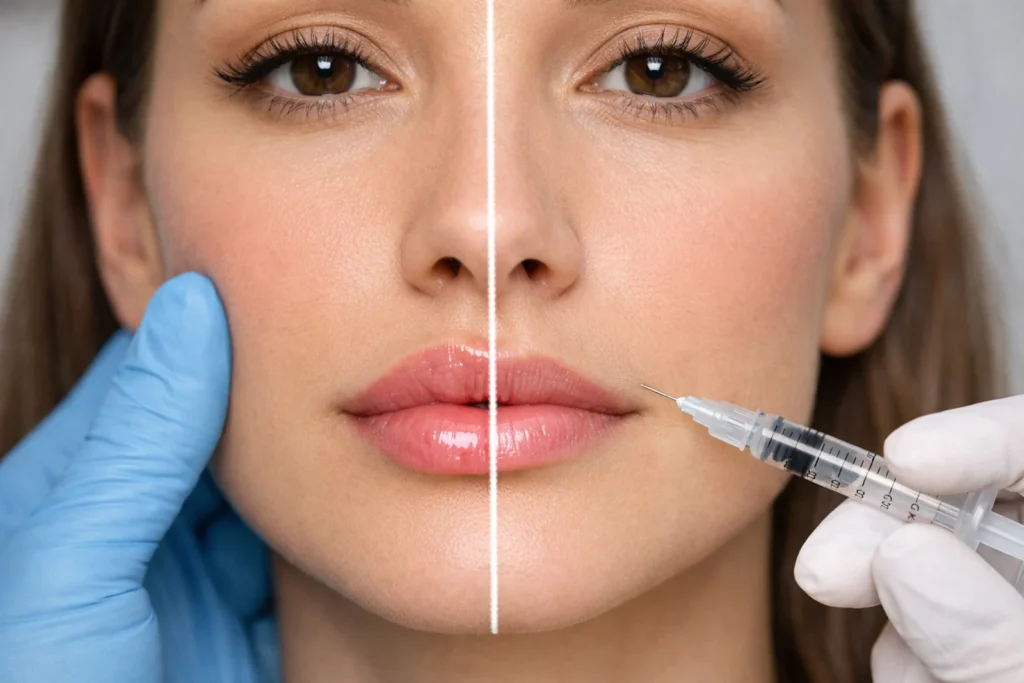
Can You Dissolve Just Half of Your Lip Filler?
Yes, But Precision Matters
You can dissolve just half of your lip filler in many cases, but the answer depends on where the filler sits, how much product remains, and how evenly it was placed in the first place. Lips do not hold filler like two neat compartments. Filler spreads through soft tissue. It integrates with the shape of the mouth. That means partial dissolving needs a careful eye, a steady hand, and a clear plan.
Many people do not want a full reset. They do not hate their lips. They simply want to correct one issue. Maybe the top lip looks too heavy. Maybe one side is higher than the other. Maybe there is a small overfilled pocket near the border. In those situations, full dissolving can feel excessive. A targeted approach often makes more sense.
What “Half” Really Means in Lip Filler Dissolving
When people say they want to dissolve half of their lip filler, they usually mean one of three things. They may want to reduce the top lip but keep the bottom lip. They may want to soften one side only. Alternatively, they may want to remove part of the volume across both lips without completely removing it.
These are not the same request. Each needs a different injection pattern. If the concern is in the upper lip, the product can often be treated there. If the issue lies in one small section, the dissolver can target that area more closely. If the lips are generally too full, the injector may dissolve in stages instead of trying to remove an exact percentage in one appointment.
That is the key point. Lip filler dissolving is not a mathematical exercise. It is a shape correction treatment.
How Partial Lip Filler Dissolving Works
To dissolve hyaluronic acid lip filler, practitioners use hyaluronidase. This enzyme breaks down the filler. In skilled hands, hyaluronidase can reduce volume in a specific part of the lips rather than wiping out the whole result.
The injector studies the lips at rest. Then they look at movement. They assess the border, the body of the lip, the projection, and the symmetry. They also check whether the issue comes from actual filler build-up or from swelling, scar tissue, migration, or poor placement. That distinction matters. Not every bump means more filler sits there.
Once the area is mapped, the injector places small amounts of dissolver into the section that needs correction. They do not need to flood the entire lip unless the product has spread widely. In many cases, less is better. Start small. Reassess. Refine.
When Dissolving Half Makes Sense
Partial dissolving works well for people who like most of their result but want one feature adjusted. It often suits:
- A bulky upper lip
Some lips look top-heavy after filler. The upper lip may push forward too much, especially in profile. Dissolving a portion of the top lip can restore balance. - Uneven lips
One side may hold more filler than the other. This can happen after the original treatment or after the swelling settles. A small amount of dissolver can even things out. - Filler migration
Sometimes filler drifts above the lip border and creates a puffy ridge. If the migration is limited, targeted dissolving may tidy that area without flattening the rest of the lips. - Small lumps or pockets
A lip can feel mostly fine but show one raised section. Dissolving that spot may smooth the shape without changing the overall look.
When Partial Dissolving Gets Tricky
Not every lip suits a half-dissolve approach. If filler sits diffusely across the lips, it may not respond in a neat, local way. If the product has layered over several appointments, the edges may blur. In those cases, dissolving only one part can create a patchy result.
Some lips also look uneven because the natural anatomy was uneven before treatment. Dissolving filler will not always fix that. It may even reveal the original asymmetry more clearly. That is why a proper assessment matters before any enzyme goes in.
It also matters that hyaluronidase does not always stop exactly where you want it to stop. It works best in targeted areas, but tissue planes are soft, and lips are highly mobile. Precision helps. Perfection is not guaranteed.
What to Expect After the Treatment
Swelling often appears after dissolving. That can confuse people. The lips may look bigger for a short time before they look smaller. This early swelling does not show the final result. The lips usually need time to settle before anyone judges the shape properly.
You may also need more than one session. A cautious injector often starts conservatively. That approach reduces the risk of over-dissolving. It is far easier to remove a little more later than to reverse a lip that has been stripped back too far.
This matters even more if you plan to refill the lips. Many people dissolve a section, wait for the tissue to calm, then add a small amount of filler with better placement. That sequence often gives a cleaner result than piling more product over an old problem.
Can You Dissolve Half of the Top Lip and Leave the Rest Alone?
Yes, often you can. This is one of the most common requests. Someone may like the fullness in the lower lip but feel the upper lip looks stiff, heavy, or overdone. In that case, dissolving part of the top lip filler can restore a better proportion.
The same applies to one side of the mouth. If the left side projects more than the right, targeted dissolving may correct the imbalance. The lips must still look natural together, so the injector will assess the whole mouth, not just the section that bothers you.
The Best Outcome Looks Balanced, Not Empty
The goal of partial dissolving is not to erase your lips. It is to restore balance, definition, and natural movement. Good correction leaves the lips looking softer, cleaner, and more in proportion with the rest of the face.
So, can you dissolve just half of your lip filler? Yes, in many cases you can. But the real question is not whether half can come out. It is whether a precise reduction will improve the shape. When the plan matches the lip, targeted dissolving can make a noticeable difference without starting from scratch.